
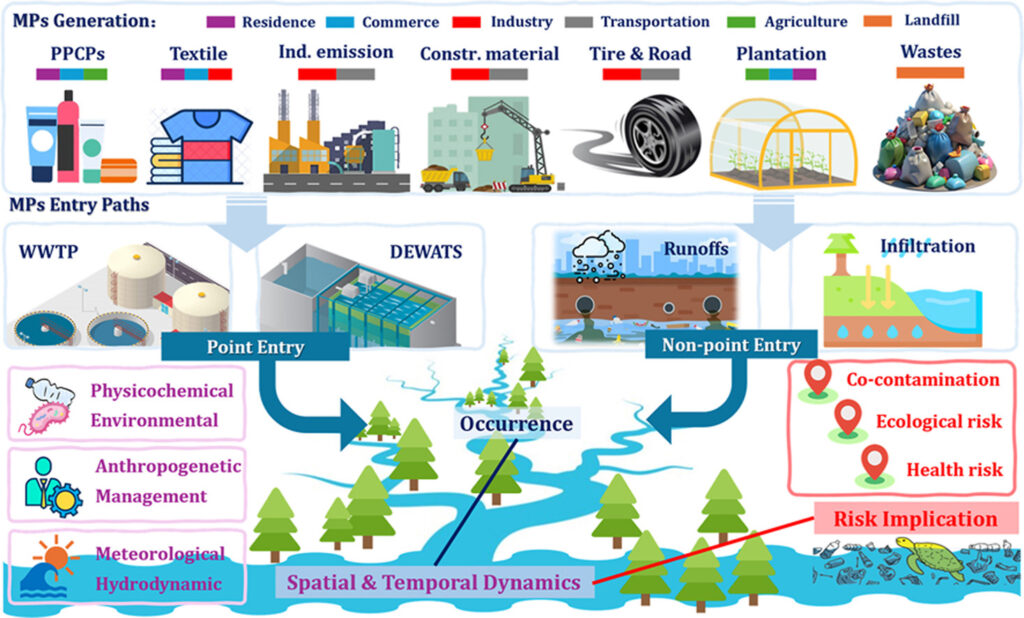
Microplastics (MPs) are increasingly recognized as pervasive contaminants in aquatic environments, yet a comprehensive regional understanding of their occurrence, transport, and risks in Southeast Asia (SEA) remains limited. This review synthesizes current knowledge on the occurrence, spatial–temporal variability, and risk implications of MPs across freshwater, marine, groundwater, drinking water, and wastewater systems in SEA. Available evidence indicates widespread MP contamination throughout the region, with concentrations generally comparable to global observations but exhibiting substantial spatial variability associated with anthropogenic activities. While differences in reported concentrations are partly influenced by methodological inconsistencies in sampling, laboratory processing, and data reporting, the consistent dominance of certain MP shapes, colors, and polymer types across water matrices suggests common sources and transport pathways throughout the region. However, limited detection of smaller particles and uneven geographical coverage continue to constrain regional comparisons and risk assessments. Current understanding of MP material flows, and transport dynamics remains fragmented, particularly under the combined influence of anthropogenic pressures, hydrodynamic processes, and climatic variability. Moreover, existing risk assessments rarely account for particle heterogeneity and environmentally realistic exposure scenarios. This review identifies key knowledge gaps and outlines future research priorities, emphasizing harmonized monitoring and data reporting, integrated source-to-sink analysis, process-based and machine learning modeling, and particle-resolved risk assessment to support effective environmental management in SEA.
📌 Read the article on the link:
🔗 https://www.sciencedirect.com/science/article/pii/S2666445326000334